
Proposal: Wavetable synth (a built-in instrument for Music mode)
Milestone: unscheduled (editor tooling, Phase 2 of the Logic-style DAW work, after the built-in effects) · Status:
proposal (2026-10-18) · Depends on: Music editor (SongEngine, IInstrument, the song model),
the Phase 1 built-in effects framework (BuiltinParam, BuiltinEffect, Effects/Dsp/, the plugin window; its design
doc docs/design/music-effects.md and ADR 0193 land with it) · ADR draft:
0195 · Related: Sound designer (ZzFX, the
other built-in instrument), Editor, Audio
Problem
Section titled “Problem”Music mode has one built-in instrument, ZzFX: a 16-voice sample player of a sound-effect line rendered once per pitch. It is good for chiptune placeholders and nothing else. Anything richer (pads, basses, leads, plucks) needs a VST3 instrument, which needs the plugin host, which only exists on the machine that has the plugin. A song made on one machine plays silence on the next, CI renders it silent, and a new user has no real instrument at all.
The DAW needs one serious instrument that is always there: a modern wavetable synth of the kind people already know how
to program (oscillators that scan a table of single-cycle frames, unison stacks, two filters, envelopes, LFOs, and a mod
matrix you assign by dragging), written in C#, with its patch stored inside the .msong like every other built-in.
- A built-in instrument,
builtin: "wavetable", selectable in the mixer’s instrument slot and the Browser like ZzFX, that works on every machine and in CI (no plugin host, no natives). - The v1 sound engine (decided with the user):
- 2 wavetable oscillators (up to 256 frames of 2048 samples, band-limited mip-maps), each with one warp mode: sync, bend, PWM, mirror, FM / AM / RM from the other oscillator;
- unison of 1–16 voices per oscillator with detune, blend, stereo width, phase and phase randomness;
- a sub oscillator and a noise oscillator;
- 2 filters (state-variable LP/HP/BP/notch/peak, ladder, comb, formant; drive, key tracking), serial or parallel;
- 4 envelopes (envelope 1 is the amp) with curved segments, 4 LFOs (tempo sync, drawable shapes);
- a mod matrix: any source → any continuous parameter, assigned by drag-and-drop onto a knob;
- polyphony up to 32, mono and legato with glide;
- an FX rack made of the Phase 1 built-in effects.
- Content: factory wavetables generated in code,
.wavwavetable import (2048-sample frames, theclmchunk), factory presets, and presets saved as.mresfiles. - A plugin window with Osc / Matrix / FX tabs, built on the Phase 1 descriptor-driven window and knobs, with the
wavetable, envelopes and LFOs drawn on an
EditorCanvas. - Real-time safe: zero allocation on the render thread, no locks, no clicks on parameter changes, deterministic offline renders.
- Our own product. Working name Mainframe Wavetable (id
wavetable). It reproduces a familiar workflow; no third-party name, branding, wavetables, presets, artwork or layout is copied.
Non-goals
Section titled “Non-goals”- A wavetable editor (drawing frames, formula or spectral editing, resynthesis of arbitrary audio into tables).
v1 imports
.wavtables and generates factory ones; editing them is a later design. - A third oscillator, sample/granular/spectral/multisample oscillator modes, a second warp slot per oscillator, spectral morphing between frames.
- Importing third-party presets (
.fxp) or reading other synths’ preset formats. Importing a.wavwavetable is in scope;.wavwith aclmchunk is a de-facto interchange format written by many tools. - An arpeggiator, chord mode, MPE / per-note expression.
- Mod-matrix routes to FX parameters (see Open questions).
- Running the synth in games. It is pure C# and could later (see Open questions); v1 is editor-only,
and games play the rendered
.oggas they do today. - Automation lanes and recorded controllers (a music-editor non-goal that still stands).
Overview
Section titled “Overview”flowchart LR
subgraph UI["UI thread"]
Win["Synth window<br/>Osc · Matrix · FX"] -- "undoable edits" --> Doc["SongDocument<br/>InstrumentDescriptor.Patch"]
Doc --> Builder["SongSnapshotBuilder.Build"]
Builder -- "Apply(patch)" --> Compiler["PatchCompiler<br/>params · routes · LFO tables · FX"]
Tables["WavetableCache<br/>(worker: mip-map build)"] --> Compiler
end
subgraph RT["Render thread (SongEngine)"]
Synth["WavetableSynth : IInstrument"] --> Voices["Voice pool (≤ 32)<br/>osc A/B · sub · noise → F1/F2 → amp"]
Voices --> Fx["FX rack<br/>(Phase 1 BuiltinEffects)"]
Fx --> Out["track buffer"]
end
Compiler -- "volatile swap: SynthProgram<br/>+ parameter version" --> Synth
The synth is an in-process IInstrument in MainframeEngine.Editor/Src/Music/Synth/, selected the way ZzFX is. The
UI thread owns everything that allocates: it parses the patch, builds wavetable mip-maps (on a worker), compiles the
mod matrix into flat arrays, and hands the render thread an immutable SynthProgram plus a lock-free parameter
block. The render thread only reads them: voice allocation, oscillators, filters, envelopes, LFOs and the FX rack run
on preallocated state.
It reuses Phase 1 throughout: parameters are BuiltinParam descriptors (ranges, curves, formatting, the knob window
generated from them), the DSP blocks come from Effects/Dsp/ (Svf, Biquad, Lfo, NoteDivision, LinearRamp,
OnePole, Oversampler2x, denormal flushing), parameter hand-off follows BuiltinEffect.Apply, and the FX rack is
a list of Phase 1 built-in effects.
Data model
Section titled “Data model”The patch lives in the track’s InstrumentDescriptor. Params cannot be reused: it is already ZzFX’s sound line
(a string), and a synth patch is more than a flat dictionary (routes, drawn LFO shapes, table references, an effect
chain). So the descriptor gains one additive object, Patch; no song format bump (an older editor keeps it in
[JsonExtensionData] Extra and plays the track silent, like any unknown built-in):
{ "id": "t2", "name": "Pad", "kind": "instrument", "instrument": { "builtin": "wavetable", "preset": "res_9c1…", "patch": { "version": 1, "params": { "a.on": 1, "a.level": 0.72, "a.wt_pos": 0.31, "a.warp_mode": 2, "a.warp": 0.4, "a.unison": 7, "a.detune": 0.22, "a.blend": 0.65, "a.width": 0.9, "a.random": 1, "b.on": 1, "b.octave": -1, "b.level": 0.5, "f1.type": 1, "f1.cutoff": 1800, "f1.reso": 0.25, "f1.keytrack": 0.5, "env1.attack": 0.02, "env1.release": 1.4, "env2.decay": 0.6, "env2.sustain": 0, "lfo1.sync": 1, "lfo1.division": 7, "voice.polyphony": 8, "voice.glide": 0 }, "tables": { "a": { "source": "factory:analog/saw-pwm" }, "b": { "source": "aud_51e…", "frameSize": 2048 } }, "lfoShapes": [ { "points": [[0, 0, 0], [0.25, 1, 0.4], [1, 0, -0.3]] }, null, null, null ], "macros": ["Brightness", "Motion", "Space", "Width"], "matrix": [ { "source": "env2", "target": "f1.cutoff", "amount": 0.45 }, { "source": "lfo1", "target": "a.wt_pos", "amount": 0.2, "bipolar": true }, { "source": "velocity", "target": "env1.level", "amount": 0.3, "aux": "macro1" } ], "fx": [ { "builtin": "chorus", "params": { "mix": 0.3 } }, { "builtin": "reverb", "params": { "size": 0.7, "mix": 0.25 }, "bypass": false } ] } }, "clips": []}paramsfollows the Phase 1 rule for built-in effects: one float per parameter id, defaults for missing ids, out-of-range values clamped, unknown ids kept. Choices and toggles are stored as their index, so choice lists are append-only (a new filter type goes at the end).tablesnames each oscillator’s wavetable:factory:<set>/<name>(generated, never stored) or a project.wavby UID (rewritten by the FileSystem panel’s reference fix-ups, as audio clips are).frameSizeoverrides the frame size for files without aclmchunk. A missing file plays the default table and sets the track status (“missing wavetable: …”).lfoShapesholds only drawn shapes ([x, y, curve]points, x and y in 0–1, curve in −1…1 bends the segment that ends at the point); built-in shapes are a parameter.matrixentries aresource,target(a parameter id),amount(−1…1, in the target’s normalized range), optionalbipolar(maps the source 0…1 to −1…1), optionalauxsource that scales the route. Up to 32 routes.fxis a list of Phase 1PluginInserts restricted to built-ins (builtin,params,bypass): the same type, the same tolerant reading, the same plugin panels.presetremembers which preset the patch came from (the window shows “Warm Pad*” once it differs). Purely UI.- Undo:
SongDocumentgainsSetSynthParam(track, id, value, mergeKey)(knob drags merge into one entry, as Phase 1’sSetInsertParam),SetSynthParams(presets, Init, Reset),SetSynthTable,AddModRoute/SetModRoute/RemoveModRoute,SetLfoShapeandSetSynthFx(add, remove, move, bypass, a parameter).
Parameters
Section titled “Parameters”All ids, ranges and curves are BuiltinParams in one registry (SynthParams), which also generates the window’s
knobs and the matrix’s target list. X stands for a or b; n for 1–4.
| Section | Parameters (id: range, default) |
|---|---|
| Oscillator A/B | X.on · X.level 0–1 (0.75) · X.pan −1…1 · X.octave −4…4 · X.semi −12…12 · X.fine −100…100 ct · X.coarse −48…48 st (continuous, a mod target) · X.wt_pos 0–1 · X.frame_mode smooth/step · X.warp_mode off, sync, bend+, bend−, PWM, mirror, FM, AM, RM · X.warp 0–1 · X.unison 1–16 · X.detune 0–1 (0.25) · X.range 0–48 st (2) · X.blend 0–1 (0.75) · X.width 0–1 (1) · X.phase 0–360° · X.random 0–1 · X.retrigger · X.to_f1, X.to_f2 (both off = straight to the amp) · X.hq (2× oversampling) |
| Sub | sub.on · sub.shape sine/triangle/saw/square · sub.octave −2…0 relative to osc A · sub.level · sub.pan · sub.to_f1, sub.to_f2 |
| Noise | noise.on · noise.type white, pink, brown, crackle, sample-and-hold · noise.color −1…1 (tilt) · noise.rate (S&H, key-tracked) · noise.level · noise.pan · noise.to_f1, noise.to_f2 |
| Filter 1/2 | fN.on · fN.type LP12, LP24, HP12, HP24, BP12, BP24, notch, peak, ladder LP24, comb+, comb−, formant · fN.cutoff 20 Hz–20 kHz (log) · fN.reso 0–1 · fN.drive 0–24 dB · fN.keytrack 0–1 · fN.mix 0–1 · filter.routing serial/parallel |
| Envelope 1–4 | envn.delay · envn.attack · envn.hold · envn.decay (0–30 s, log) · envn.sustain 0–1 · envn.release 0–30 s · envn.attack_curve, envn.decay_curve, envn.release_curve −1…1 · env1.level (amp, 0–1) |
| LFO 1–4 | lfon.shape sine, triangle, saw up, saw down, square, sample-and-hold, smooth random, drawn · lfon.rate 0.01–100 Hz (log) · lfon.sync · lfon.division (Phase 1 NoteDivision: 8 bars … 1/64, dotted, triplet) · lfon.mode free, retrigger, envelope (one-shot) · lfon.global · lfon.delay · lfon.rise · lfon.phase · lfon.smooth |
| Voicing | voice.polyphony 1–32 (8) · voice.mode poly, mono, legato · voice.glide 0–5 s · voice.glide_mode always/legato · voice.bend_range 0–24 st (2) |
| Macros, master | macro1…macro4 0–1 · master.volume −60…+6 dB · master.pan |
Mod sources: env1–env4, lfo1–lfo4, velocity, note (key 0–127 → 0–1), random (per note-on),
macro1–macro4, modwheel, aftertouch, pitchbend (see Open questions for the controller
path). Every source outputs 0…1 (pitch bend −1…1); a route’s bipolar maps 0…1 to −1…1. Targets are the
continuous parameters above (not choices or toggles), including env1.level (velocity → amp) and LFO rates.
Voice architecture and DSP
Section titled “Voice architecture and DSP”flowchart LR
A["Osc A<br/>unison ×1–16"] --> R{"routing<br/>F1 · F2 · both · direct"}
B["Osc B<br/>unison ×1–16"] --> R
S["Sub"] --> R
N["Noise"] --> R
B -. "FM / AM / RM" .-> A
R --> F1["Filter 1"] --> F2["Filter 2"]
R --> F2
F1 -. "parallel" .-> Amp
F2 --> Amp["Amp<br/>Env 1 × velocity × level"]
R -- "direct" --> Amp
Amp --> Sum(("Σ voices")) --> FX["FX rack"] --> M["master volume / pan"]
Per voice: oscillator A and B (each a unison stack), sub and noise → each source to filter 1, filter 2, both or
straight to the amp → filters (serial: F1 into F2; parallel: summed) → amp (envelope 1 × velocity route × level) →
stereo sum. All voices sum into the instrument bus → FX rack → master volume/pan → the track buffer (added, as
IInstrument.Process requires).
Wavetables: band-limited mip-maps
Section titled “Wavetables: band-limited mip-maps”A wavetable is 1–256 frames of 2048 samples, one cycle each. The cache turns it into a mip-mapped table on a
worker thread when first used (WavetableCache, keyed by source + frame size, shared by every track and both
oscillators; release by reference count when no program uses it):
- Per frame: remove DC, real FFT (2048 points: a small radix-2
FftinSynth/Dsp/, no package), keep bins 1…1024. - Level L = 0…10 keeps harmonics
1 … H_LwithH_L = 1024 >> L, inverse-FFT intoN_L = clamp(4·H_L, 64, 2048)samples (2048, 2048, 1024, 512, 256, 128, then 64 for levels 6–10). A level is ~3.1 frames of memory in total, so a 256-frame table is about 6.5 MB of floats; factory tables (16–64 frames) are 0.4–1.6 MB. - Each level keeps a 3-sample guard at both ends so the 4-point read never wraps.
Choosing the level. Aliases that fold back above 20 kHz are inaudible, so a harmonic may go up to
F_max = max(fs − 20 kHz, fs / 2) (28 kHz at 48 kHz, 24.1 kHz at 44.1 kHz) instead of Nyquist. For a playback
frequency f the level is the smallest L with H_L · f ≤ F_max:
L = clamp(ceil(log2(1024 · f / F_max)), 0, 10)So nothing audible ever aliases, and the worst case (just above a level boundary) still keeps harmonics up to
F_max / 2 (14 kHz at 48 kHz). f is the oscillator’s highest effective frequency in the block: the note with pitch
modulation and glide, times the unison voice’s detune, times the sync ratio for sync warp. The level is chosen once
per voice per control step (below); when it changes, the oscillator reads both levels and crossfades over that step,
so sweeping a note across a boundary does not click.
Reading. Each unison voice has a 32-bit unsigned phase accumulator (wraps for free, identical on every CPU; the
increment is round(f / fs · 2³²)). The index into a level of length N_L = 2^k is phase >> (32 − k), the fraction
the remaining bits. Samples are read with a 4-point, 3rd-order Hermite interpolator (two frames → 8 reads), which at
≥ 4 samples per period of the highest harmonic keeps interpolation images under about −70 dB.
Frame position. wt_pos (0–1, modulated) selects a fractional frame p = wt_pos · (frames − 1). Smooth mode
crossfades frames ⌊p⌋ and ⌊p⌋+1 linearly; step plays ⌊p + 0.5⌋ (a stepped, digital sound).
Warp modes
Section titled “Warp modes”One warp per oscillator, with amount a in 0–1. Warps reshape the phase φ (0…1) before the table read, or combine
the output with the other oscillator. φ_w is the phase actually read; y_A, y_B are the oscillators’ outputs.
| Mode | Math | Notes |
|---|---|---|
| Sync (windowed) | r = 2^(4a) (1–16×); φ_w = frac(φ · r); output × w(φ) = sin(π·φ)^0.5 blended in by a | the window hides the reset discontinuity; the level is chosen for f · r |
| Bend+ / Bend− | φ_w = φ^γ, γ = 2^(−3a) (bend+) or 2^(3a) (bend−) | squeezes the cycle toward its start or end; a = 0 is the identity |
| PWM | w = 1 − 0.98a; φ_w = φ / w for φ < w, else the output is 0 | the cycle plays in the first w of the period |
| Mirror | m = 2φ for φ < ½, else 2 − 2φ; output (1 − a)·y(φ) + a·y(m) | forward then backward in each period |
| FM (from the other osc) | φ_w = frac(φ + I · y_other), I = 4a (cycles) | phase modulation: through-zero, pitch-stable; hq 2× oversamples it |
| AM | y = y_A · ((1 − a) + a · (0.5 + 0.5 y_B)) | |
| RM | y = y_A · ((1 − a) + a · y_B) |
FM, AM and RM read the other oscillator’s sample for the same unison voice index (i mod unisonOther). When A and B
modulate each other, B uses A’s previous sample (a one-sample feedback path; no cycle). FM and hard sync create
partials the mip level cannot remove; X.hq runs that oscillator at 2× with the Phase 1 Oversampler2x and is off by
default (the CPU table below counts it separately).
Unison
Section titled “Unison”For N voices, voice i has a position u_i = −1 + 2i/(N − 1) (0 when N = 1):
- Detune:
cents_i = u_i · detune · range · 100;rangeisX.rangesemitones (2 by default, so detune 1.0 is ±2 semitones at the outer voices). - Blend: the centre voice (the two centre voices when
Nis even) has gain1 − blend, the othersblend; the stack is then scaled by1 / sqrt(Σ g_i²), so loudness stays steady asNor blend change (detuned voices are uncorrelated, so their power adds). - Width: voice
ipans tou_i · widthwith the equal-power law (AudioMath.PanGains), so pitch spreads across the stereo field andwidth = 0is mono. - Phase: at note-on each voice starts at
phase + random · ρ_i(ρ uniform in 0–1, from the voice’s RNG); withretriggeroff the oscillator is free-running (phase continues from the voice slot’s last note). - Determinism: each voice’s RNG (xorshift32) is seeded from the note’s start frame, pitch and unison index, so an offline render of the same song is bit-identical every time and on every machine with the same floating-point mode.
Sub and noise
Section titled “Sub and noise”- Sub: sine, triangle, saw or square, one or two octaves below oscillator A (or at its pitch), band-limited with a small built-in factory table through the same mip-map reader. No unison.
- Noise: white (xorshift), pink (Paul Kellet’s 7-pole filter), brown (leaky integrator), crackle (sparse random
impulses) and sample-and-hold (rate key-tracked), with a tilt
color(a one-pole shelf). Stereo: two independent generators panned bynoise.pan.
Filters
Section titled “Filters”Two filters per voice, stereo (unison width makes the voice stereo before the filter):
| Type | Implementation |
|---|---|
| LP/HP/BP 12, notch, peak | Phase 1 Svf (TPT, Zavalishin), one stage |
| LP/HP/BP 24 | two cascaded Svf stages; resonance on the second |
| Ladder LP24 | a TPT 4-pole ladder with a tanh stage per pole (drive and resonance interact like the analog circuit); self-oscillates at reso 1, bounded by the nonlinearity |
| Comb+ / Comb− | a delay of 1 / cutoff seconds (Phase 1 DelayLine, Hermite), feedback ±0.98·reso, damping in the loop |
| Formant | three parallel band-passes at vowel formants (A–E–I–O–U table), cutoff morphs along the vowels, reso is the bandwidth |
- Drive is
tanh(g·x)/tanh(g)before the filter,gfrom 0–24 dB. - Key tracking:
cutoff · 2^(keytrack · (note − 60) / 12). - Coefficients (
g = tan(π·fc/fs)) are computed once per control step at the step’s end value and interpolated linearly per sample;fcis clamped to0.49·fs. - Routing: serial (F1 → F2; sources routed only to F2 skip F1) or parallel (F1 + F2).
mixcrossfades dry/wet per filter.
Envelopes
Section titled “Envelopes”Delay → attack → hold → decay → sustain → release; times 0–30 s on a log curve (the knob’s middle is ~0.3 s). Each
curved segment maps its progress x (0…1) through s(x) = (e^{kx} − 1)/(e^k − 1) with k = 6c for curve c ∈ [−1, 1] (c = 0: linear). Attack defaults to slightly convex, decay and release to exponential-like (c = −0.6).
A note-off during attack or decay releases from the current level (no jump); a retriggered voice restarts the attack
from its current level, not from zero. Envelope 1 drives the amp; a voice is freed when envelope 1 finishes its
release (below −96 dB).
Built-in shapes or a drawn shape (up to 64 points with curved segments) baked by the UI thread into a 1024-entry
table. Rate in Hz or tempo-synced through Phase 1 NoteDivision; free LFOs (per voice, phase continues),
retrigger (restart at phase on each note-on) and envelope (one cycle, then hold the last value). A global
LFO runs once per instrument; when synced and the song is playing, its phase is derived from the song position
(EffectContext.PositionFrames), so it lands on the same beat in every playback and in renders. delay and rise
fade it in; smooth low-passes the output (useful on S&H).
Mod matrix: control rate and smoothing
Section titled “Mod matrix: control rate and smoothing”Modulation is evaluated at a control rate of one step per 16 frames (3 kHz at 48 kHz), the usual split between cost and accuracy:
- At each control step, per voice: advance envelopes and per-voice LFOs to the step’s end, read the global sources (global LFOs, macros, controllers), and evaluate the compiled routes.
- For each modulated target:
v_norm = clamp(base_norm + Σ amount_r · s_r · aux_r, 0, 1), thenBuiltinParamdenormalizes it. Working in normalized space means a cutoff route moves in octaves (the log curve) and a level route in linear gain, with the same amount semantics everywhere. - Audio-rate consumers (pitch → phase increment, level, pan, wavetable position, warp amount, filter coefficients) ramp linearly across the 16 frames from the previous step’s value, so a 0 ms attack is a 0.33 ms ramp and nothing zippers.
The routes are compiled on the UI thread into flat arrays (ModRoute { short Source, Target, Aux; float Amount; bool Bipolar }, sorted by target) with per-voice source values in a float[voices, sources] block, so evaluation is a
tight loop with no lookups. A per-voice source routed to a global target (an FX parameter later, master.volume now)
uses the most recently started voice. Pitch modulation is summed in semitones before one exp2 per voice per step.
Base-value smoothing. Knob changes, preset loads and undo arrive as new base values; each continuous parameter
glides to its new base with a 20 ms LinearRamp (Phase 1), so a knob drag on a playing note is click-free. Choices
and toggles switch at the next note-on for voice structure (unison, warp_mode, filter type), or immediately with
a 5 ms crossfade for what can change under a sounding voice (filter type, warp mode).
Voice management
Section titled “Voice management”- Poly: up to
voice.polyphonyvoices (1–32). Stealing order: the oldest released voice, then the oldest held voice; a stolen voice fades out over 3 ms in a reserved tail slot (polyphony + 4 slots are allocated) while the new note starts at once. - Mono / legato: one voice, last-note priority with a held-note stack (returning to a still-held note on release). Legato does not retrigger envelopes or LFOs on overlapping notes.
- Glide: constant-time portamento in pitch (semitones),
alwaysor only between overlapping notes. AllNotesOff(stop, seek) releases every voice over 5 ms, as the ZzFX instrument does.
Threading and zero allocation
Section titled “Threading and zero allocation”The render thread is the SongEngine’s; the rules are the music editor’s (no allocation after preparation, no locks)
plus Phase 1’s parameter hand-off:
WavetableSynth : IInstrumentis created once per track slot while the instrument key staysbuiltin:wavetable(the existingSongSnapshotBuilder.InstrumentKey), so DSP state survives edits. EveryBuildcallssynth.Apply(descriptor.Patch)on the UI thread, the same hook Phase 1 adds for built-in effects (anIBuiltinInstrumentinterface the builder recognizes).- Two hand-off paths:
- Parameter values (the common case: a knob drag):
Applywrites the 200-odd base values into afloat[]with volatile writes and bumps a version, exactly likeBuiltinEffect.Apply. The render thread copies them into its own array when the version changes and starts the smoothing ramps. - Structure (routes, tables, drawn LFO shapes, the FX list):
Applybuilds a new immutableSynthProgramand publishes it withVolatile.Write. The render thread picks it up at the next block boundary. A program holds only arrays sized at compile time; nothing on the render thread grows.
- Parameter values (the common case: a knob drag):
- Wavetables are built by
WavetableCacheon a worker task (a 256-frame import takes tens of milliseconds). Until a table is ready the program keeps the previous table (or the default saw), and the nextBuildafter completion publishes it. The cache never runs on the render thread. - Preallocated state: voices (
polyphony+ 4 tail slots, at the 32-voice maximum: the pool does not reallocate when polyphony changes), 16 unison phase accumulators per oscillator, per-voice filter state, LFO/envelope state, control-step scratch, and the FX rack’s own Phase 1 buffers. About 200 KB per synth instance. - The
IInstrumentsignature gains the Phase 1in EffectContext ctx(tempo, playing, position) for tempo-synced LFOs and the FX rack; the ZzFX and VST3 instruments ignore it. - Floating point: denormals are flushed explicitly at filter and feedback states (Phase 1’s helper); no NaN can escape (the ladder and comb clamp their states), and a test runs the synth through 60 s of silence after a loud note.
- CPU meter: each
Processmeasures itself withStopwatch.GetTimestamp()(no allocation) and publishes a smoothed load (percentage of the block’s real-time duration) the window shows next to the voice count.
CPU budget
Section titled “CPU budget”Targets for a Release build on the reference machine (Apple M1, one core), at 48 kHz, 256-frame blocks (5.33 ms
of real time each), measured by the benchmark suite (Tests/MainframeEngine.Benchmarks, compared against
baseline.json by just bench):
| Patch | Voices × oscillators × unison | Target (share of one core) |
|---|---|---|
| Init (1 osc, no unison, 1 filter) | 1 × 1 × 1 | ≤ 0.3 % |
| Typical lead (2 osc, 2 filters, 4 routes) | 1 × 2 × 4 | ≤ 1 % |
| Supersaw pad | 8 × 2 × 7 | ≤ 8 % |
| Worst case (all modulated, both filters, FX rack of 4) | 16 × 2 × 16 | ≤ 40 % (a block in ≤ 2.1 ms) |
Worst case with hq on both oscillators | 16 × 2 × 16 | ≤ 75 % |
How it is reached: 32-bit integer phases; 16 unison lanes processed with System.Numerics.Vector<T> /
Vector128 for phase, pan and gain math (the table reads are scalar gathers); one mip level and one exp2 per voice
per control step, not per sample; filter coefficients per control step; silent sources (on off, level 0) skipped;
and an idle synth (no voices, FX tails decayed) costs nothing. Polyphony × unison past the worst case is allowed but
may miss deadlines; the CPU meter turns amber over 70 %.
Wavetable sources
Section titled “Wavetable sources”Factory wavetables (code-generated)
Section titled “Factory wavetables (code-generated)”FactoryWavetables generates every factory table deterministically from code at first use; none are stored in the
repository or in songs, and all are original. About 30 tables in five sets:
| Set | Examples (how each is made) |
|---|---|
| Basic | sine → triangle → saw → square morph; pure saw; pure square |
| Analog | PWM sweep; saw with a drifting low-pass; stacked detuned saws; “sync sweep” (hard-sync ratios 1–8) |
| Harmonic | additive build-ups (1 → 64 harmonics), odd-only and even-only sweeps, a bell (inharmonic partials folded in) |
| Formant | additive frames shaped by vowel formant envelopes (A → E → I → O → U), a vocal “yeah” morph |
| Digital | bit-reduced and sample-rate-reduced saws, FM sweeps (ratio 1–8, index 0–8), waveshaped and wavefolded sines |
Generation runs once per process on the worker (a few milliseconds per table), then goes through the same mip-map build as an imported table.
.wav import
Section titled “.wav import”A project .wav becomes a wavetable when an oscillator’s table menu picks it (“Import Wavetable…” opens the file
picker and copies an outside file into Assets/Wavetables/, the default folder). The file stays an ordinary audio
asset; its patch reference is its UID.
- Frame size comes from the
clmchunk when present: its text starts with<!>followed by the frame size in decimal (<!>2048 …); the flags after it are ignored. Without the chunk: theframeSizestored in the patch reference, else 2048 when the sample count is a multiple of 2048, else the whole file is one single-cycle frame. The table menu offers frame sizes 256, 512, 1024, 2048, 4096 and “single cycle” to override. - Frames of another size are resampled to 2048 in the frequency domain (FFT, pad or truncate the spectrum, inverse FFT), so they stay band-limited.
- Channels are mixed to mono; 8/16/24/32-bit PCM and 32-bit float are read by a small RIFF reader in
Synth/(the engine’s decoders resample and stream, which a table import must not do). - At most 256 frames (the rest is dropped with a warning in the Output panel); each frame has its DC removed; the table is peak-normalized as a whole (not per frame, so a quiet frame stays quiet).
- Malformed files (no
fmt/data, zero frames) are refused with a message; the oscillator keeps its table.
Presets
Section titled “Presets”- Factory presets (about 40: basses, leads, pads, plucks, keys, FX) are written in C# (
FactoryPresets, a patch per preset built from the parameter registry), so they always match the current parameter set and use only factory tables. - User presets are
.mresresources of a new type,WavetablePreset:Name,Category,Author,TagsandPatch(the patch JSON as written in the.msong, canonical form). The editor has no source generator (its nodes stay unregistered on purpose), so the type lives in the engine core (MainframeEngine/Src/Audio/Synth/WavetablePreset.cs), where the generator registers it and a future runtime synth can load it. Default folder:Assets/Presets/Wavetable/. A preset that references a.wavtable references it by UID like any resource. - The preset menu in the window header (Phase 1’s Presets button, extended): Init, the factory categories, the
project’s presets (found by type through the
AssetDatabase), Save Preset… / Save As…. Loading a preset is one undo step (SetSynthParams+ tables + matrix + FX together). Next/previous arrows step through the current category.
The synth window (UI)
Section titled “The synth window (UI)”The Phase 1 plugin window in a larger size (920 × 600 dp, resizable down to 760 × 520), opened from the instrument slot (mixer strip, track header) or by double-clicking the instrument in the Browser. One window per instrument at a time, like the insert windows; its position is saved. The header is Phase 1’s (power, “Mainframe Wavetable — Pad — Theme”, presets, Reset, close) plus the CPU meter and active voice count, then the tab bar Osc · Matrix · FX (the user’s three tabs) and, always visible along the bottom, the modulation strip: Env 1–4, LFO 1–4, Macros 1–4, Velocity, Note, Mod wheel. The tab is remembered per window.
Osc tab
Section titled “Osc tab”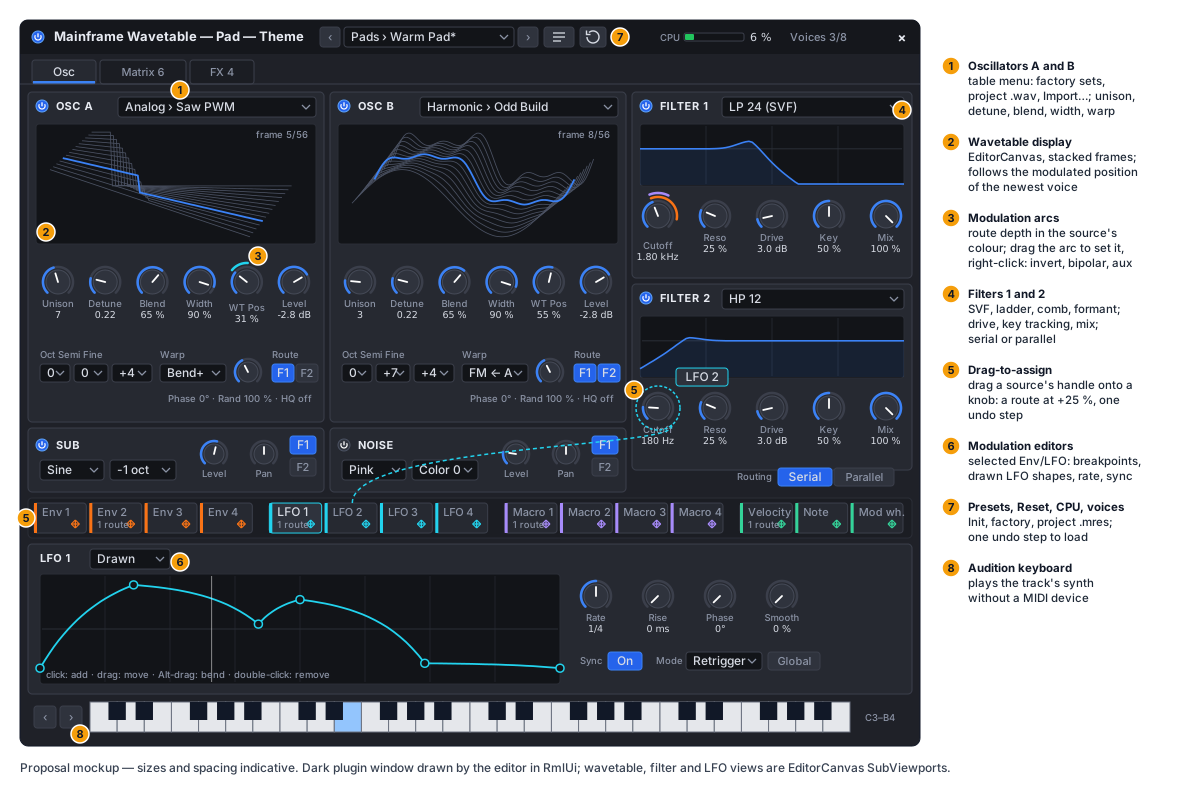
- Oscillator A and B panels: on/off, the table menu (factory sets, project tables, Import Wavetable…), the wavetable display, then knobs: octave/semi/fine (steppers), unison, detune, blend, width, wt pos, warp mode (menu) + warp, phase, random, level, pan; the filter-routing toggles F1/F2.
- Wavetable display (
WavetableCanvas : EditorCanvas, oneSubViewportper oscillator,engine://synth-osc-a): the frames drawn as a stacked pseudo-3D view (up to 32 frames, each a 128-point polyline, the current frame bright) or a flat view of the current frame (click toggles). With voices sounding, the frame drawn follows the modulated position of the newest voice, which the render thread publishes as a float (lock-free, read once per editor frame). It redraws only when the table, position or size changes, from a preallocatedVector2[]; the 2048-sample frame is reduced to 128 min/max points when the table is built, not per frame. - Sub and noise are compact rows under the oscillators; Filter 1 and 2 sit at the right with a type menu,
cutoff, resonance, drive, key tracking, mix, the serial/parallel switch, and a response curve (
FilterCanvas) computed from the same coefficients (MagnitudeDb, shared with the EQ graph in Phase 1). - Bottom: modulation editors. Selecting an Env or LFO tile in the modulation strip shows its editor: the envelope
curve with draggable breakpoints (time and curve per segment), or the LFO shape with rate, sync and mode. In drawn
mode, click adds a point, drag moves it, Alt-drag bends the segment, double-click removes it; edits are
SetLfoShapesteps (one undo entry per drag).
Drag-to-assign modulation
Section titled “Drag-to-assign modulation”- Every source tile in the modulation strip has a drag handle (a crossed-arrows icon, tooltip “Drag onto a knob to
modulate it”). Dragging it creates a
SynthModDrag(source)with a ghost after a 4 dp move (the Phase 1 Browser’s drag pattern); continuous knobs carrydata-drop="mod:<param id>"and highlight while a drag hovers them. - Dropping on a knob adds a route (
AddModRoute, amount +25 %, unipolar) or, if that source already modulates the knob, selects the existing route. Choices and toggles do not accept drops. - A modulated knob shows an arc in the source’s colour around it, from the base value to base + amount; several routes stack as concentric arcs. Dragging on the arc (or Alt-drag on the knob) sets the selected route’s amount; the value readout shows “Env 2 → Cutoff +45 %”. While a note plays, a small dot on the arc shows the live modulated value.
- Right-click on a modulated knob lists its routes: invert, bipolar, set aux source, remove. Removing the last route removes the arc.
- Each tile shows how many routes it drives; hovering a tile highlights its targets.
Matrix tab
Section titled “Matrix tab”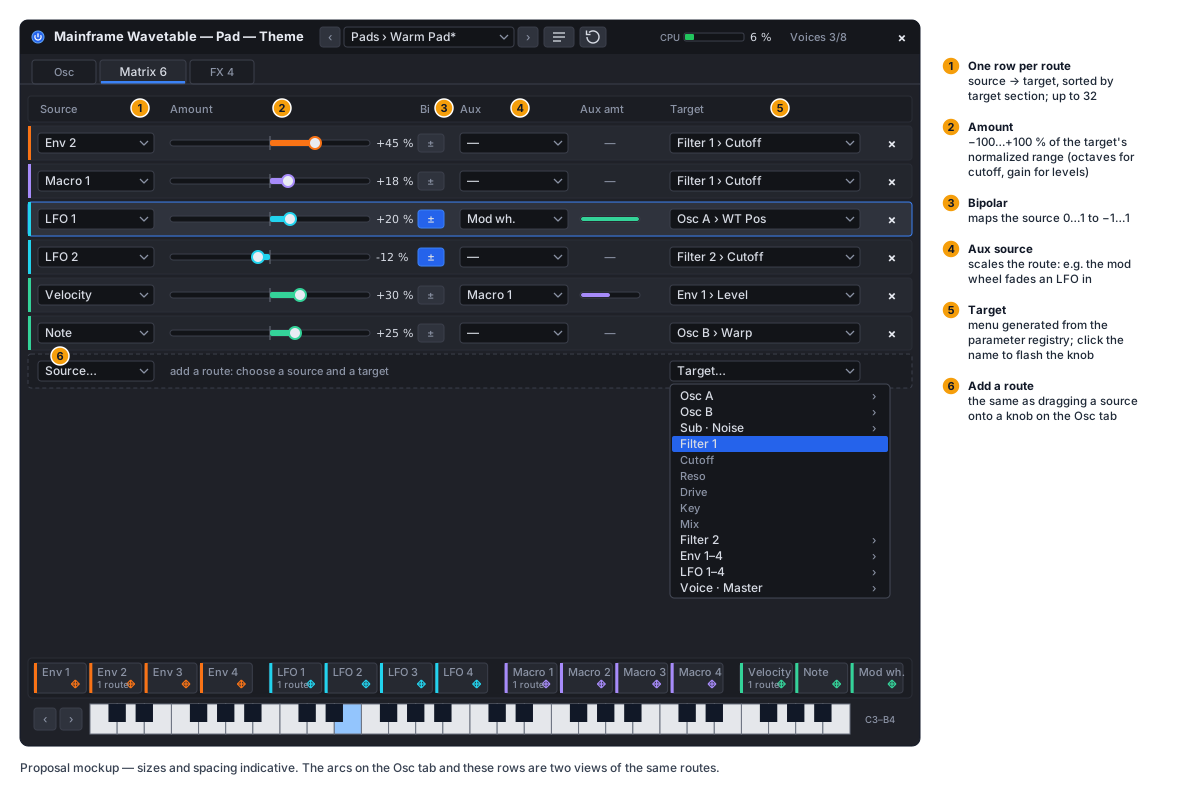
A table of every route (the same data the arcs show): source, amount (a horizontal slider centred on 0), the bipolar
toggle, aux source, aux amount, target, and a remove button; an empty last row adds a route by choosing source
and target from menus (the target menu is grouped by section and generated from SynthParams). Rows sort by target
section. Clicking a target name switches to the Osc tab and flashes that knob. Up to 32 routes; the count shows in the
tab title (“Matrix 6”).
FX tab
Section titled “FX tab”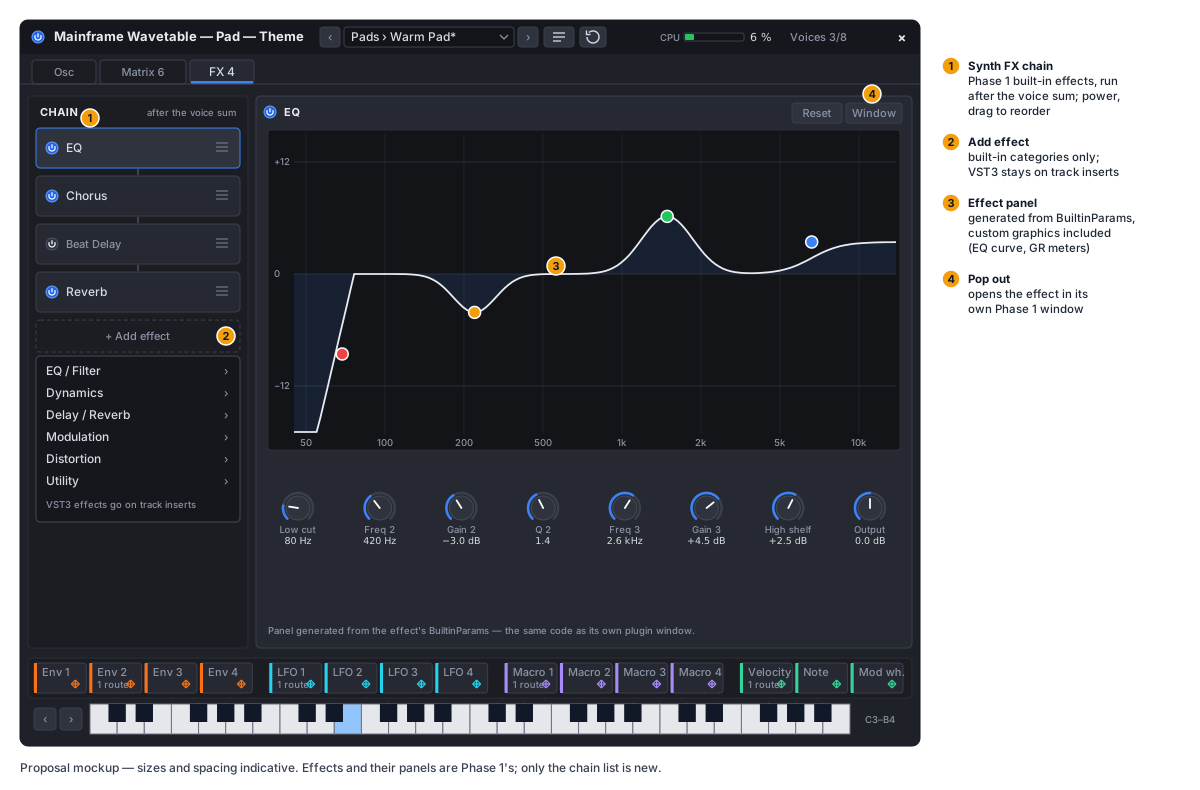
The synth’s own effect chain, made of Phase 1 built-in effects: a vertical list of slots on the left (power, name,
drag to reorder, ”+” opens the built-in categories menu; VST3 effects are not offered here, they belong on the track’s
inserts) and, on the right, the selected effect’s panel, generated from its BuiltinParams by the same code as its
own plugin window, including custom graphics (the EQ curve, gain-reduction meters). The chain runs after the voice sum
and before the synth’s master volume.
Window behaviour
Section titled “Window behaviour”- Knob gestures are Phase 1’s (vertical drag, Shift fine, wheel, double-click reset, each drag one undo step).
- Read-only songs disable editing; the window still shows the patch and plays notes.
- Clicking the piano keyboard strip at the window’s bottom edge (a two-octave strip, octave shift buttons) auditions
the patch through the track (
SongPlayer’s preview-note path), without a MIDI device. - The window closes when its track disappears (undo, tab switch), as Phase 1’s windows do.
Reusing the Phase 1 framework
Section titled “Reusing the Phase 1 framework”| Phase 1 piece | Used by the synth for |
|---|---|
BuiltinParam, ParamCurve, Normalize/Format | every synth parameter, the matrix’s normalized math, readouts |
BuiltinEffect.Apply hand-off (volatile writes + version) | the synth’s base-value block |
Effects/Dsp/Svf, Biquad + MagnitudeDb | filters and the filter curve display |
Lfo, NoteDivision | LFO phase and tempo sync (the synth adds drawn shapes on top) |
LinearRamp, OnePole | base-value smoothing, LFO smooth, noise colour |
DelayLine | comb filters |
Oversampler2x | hq oscillators |
EffectContext | tempo, transport and position for synced LFOs and the FX rack |
BuiltinEffects registry + effects | the FX tab’s chain and its panels |
| Plugin window, knobs, popups, presets button, drag ghost | the synth window’s chrome and gestures |
PluginInsert (Builtin, Params, Bypass) | the patch.fx entries |
New in Phase 2: Synth/ (WavetableSynth, SynthProgram, PatchCompiler, SynthParams, Voice, Oscillator,
Warp, Filters (ladder, comb, formant), Envelope, WavetableCache, Wavetable, FactoryWavetables,
FactoryPresets, WavetableWav, Dsp/Fft), IBuiltinInstrument, the synth window
(UI/SynthWindow.cs, Assets/Editor/synth_window.rml, WavetableCanvas, EnvelopeCanvas, LfoCanvas,
FilterCanvas) and the engine’s WavetablePreset resource.
Error handling
Section titled “Error handling”| Situation | Behaviour |
|---|---|
Wavetable .wav missing | default table plays; track status “missing wavetable: Assets/Wavetables/x.wav”; reference kept |
.wav malformed or not a table | refused at import with a message; an existing reference shows the status above |
| Unknown parameter id / route target / source | kept in the file, ignored by the compiler; the Matrix tab shows the route greyed (“unknown target”) |
Unknown effect in patch.fx | pass-through, as Phase 1 |
Patch version newer than this editor | the track plays what it understands; the window opens read-only with a notice |
| Older editor opens a song with the synth | it keeps patch in Extra; the track is silent (unknown built-in) |
| Render-thread overload | the block is late like any other (xrun counter); the CPU meter shows it |
Testing
Section titled “Testing”New tests in Tests/MainframeEngine.Editor.Tests/Music/Synth/ (all without audio devices, ffmpeg or the helper):
- Mip-maps: each level of each factory table has no energy above
H_L(FFT of the level, < −120 dB); level selection follows the formula at 44.1 and 48 kHz; tables with 1, 2, 256 and 300 frames (the last truncated). - Aliasing: render a saw sweep 20 Hz → 20 kHz and a fixed set of notes (A0 … C8) at 48 kHz; measure, by FFT,
every component below 20 kHz that is not a harmonic: ≤ −70 dB relative to the fundamental (mip-maps alone). FM and
sync with
hqon are measured againsthqoff and must improve by ≥ 20 dB. - Warp math: each warp function at known phases;
a = 0is the identity for every mode (sample-identical output); sync’s level selection usesf · r. - Unison:
N = 1equals a single oscillator; measured detune frequencies; RMS within ±1 dB acrossN1–16 and blend 0–1; pan law; width 0 is mono. - Envelopes and LFOs: segment lengths in frames (± one control step); release from mid-attack starts at the current level; tempo-synced LFO period (1/4 at 120 BPM = 24 000 frames at 48 kHz) and phase locked to the song position.
- Filters: SVF −3 dB at cutoff (LP12, Q 0.707), 24 dB/oct slopes, key tracking, ladder and comb stay bounded at maximum resonance and drive; no NaN or denormals after 60 s of silence.
- Mod matrix: compiled routes give the expected parameter values (normalized math, clamping, aux scaling, bipolar); smoothing ramps reach their target within 20 ms; no clicks (maximum sample-to-sample step bounded) on knob changes during a held note.
- Voices: stealing order, tail fade, mono/legato note stack, glide time,
AllNotesOff. - Determinism: the same song renders bit-identical twice (seeded RNGs, integer phases).
- Allocation: zero bytes (
GC.GetAllocatedBytesForCurrentThread) across 1 000 blocks at 16 voices × 16 unison, with parameter changes, program swaps, table swaps, note storms, voice stealing and FX bypass toggles. - CPU: the benchmark table above in
Tests/MainframeEngine.Benchmarks(regressions againstbaseline.json), plus a CI-safe unit test that the supersaw pad renders 1 s of audio in under 0.5 s on any runner (catches gross regressions without timing flakiness). - Data model: patch JSON round trip; missing parameters read defaults, out-of-range values clamp, unknown ids, sources, targets and effects are preserved byte for byte; undo/merge of knob drags, route edits and preset loads.
- Import:
clmchunk parsing, each fallback, frame resampling, 8/16/24/32-bit and float files, stereo mixdown, malformed files. - Goldens and QA: render-test goldens of the three tabs (
editor-synth-osc,editor-synth-matrix,editor-synth-fx, both drivers);editor-music-songgains a synth track so the allocation gate covers it. QA verbssong synth-window,synth tab,synth mod-dragand a walkthrough capture of each tab;just qa-editorand inspect by eye.
Delivery
Section titled “Delivery”Four PRs after Phase 1’s A1 (framework) and E (plugin window); 1 → 2 → 3 → 4, with 2 able to run beside 3:
- Synth engine, no window:
Synth/DSP (tables + FFT + factory tables, oscillators, warps, unison, sub, noise, filters, envelopes, LFOs, matrix compiler, voices),WavetableSynth,IBuiltinInstrumentand theEffectContextonIInstrument, thepatchdata model andSongDocumentmethods, “Wavetable” in the instrument slot and the Browser (Init patch; parameters editable through the generic Phase 1 knob window as a stopgap), benchmarks and the DSP, allocation, determinism and data-model tests. - Content:
.wavimport, factory presets, theWavetablePresetresource and the preset menu, the table menu. - Synth window, Osc tab: the larger window,
WavetableCanvas,FilterCanvas, envelope and LFO editors (drawn LFOs), modulation strip, drag-to-assign and the knob arcs. - Matrix and FX tabs, docs: the Matrix table, the FX rack with embedded effect panels, the CPU meter, goldens, QA
verbs and captures; the as-built
docs/design/wavetable-synth.md(this proposal rewritten), editor.md (song tab), the milestone row, the landing page’s DAW section and the README with screenshots.
As built: PR 1 (synth engine)
Section titled “As built: PR 1 (synth engine)”PR 1 is in MainframeEngine.Editor/Src/Music/Synth/: SynthParams (the registry, ~170 parameters, the sources),
SynthPatch (the data model), Wavetable and Dsp/Fft (mip levels), FactoryWavetables and WavetableCache (16
factory tables built on a worker), SynthDsp (envelope, LFO, filters, noise), SynthVoice and WavetableSynth. The
song’s other pieces: IBuiltinInstrument (the builder calls Apply on every build), IInstrument.Process with the
EffectContext, NoteEventKind controller events from SongMidiInput through SongEngine.Controller, SongDocument’s
synth edits, “Mainframe Wavetable” in the instrument slot menu and the Browser’s Instruments group, and the plugin
window showing every parameter as a knob (PluginWindow.OpenSynth) until the synth’s own window (PR 3).
Differences from the proposal above:
- Mip levels hold 8 samples per top harmonic (128 to 4096 samples), not 4. At 4, the 4-point Hermite read’s images
of the top harmonics fold back past Nyquist at about −50 dB (C6 at 48 kHz); at 8 every note A0–C8 stays under −70 dB
(
SynthDspTests.ASawNeverAliasesAudibly). A 256-frame table is about 13 MB. - Unison is power-normalized across both channels (to one centred lane), so a wide stack is as loud as a narrow one.
- Filter coefficients change once per control step (no per-sample interpolation), and a filter type change resets that filter (no 5 ms crossfade yet).
- The 12 dB state-variable types are Butterworth (Q 0.707) at zero resonance, so LP 12 is −3 dB at its cutoff.
- Factory wavetables: 16 tables in the five sets (basic, analog, harmonic, formant, digital); presets,
.wavimport and the preset resource are PR 2.
Measured (just bench '*SynthBenchmarks*', Release, Apple Silicon, one 256-frame block at 48 kHz = 5.33 ms): Init
11.5 µs (0.2 %), lead 24.7 µs (0.5 %), supersaw pad 216 µs (4.0 %), worst case 16 × 2 × 16 with a ladder and four
effects 1.04 ms (19.5 %); zero allocation in every case.
As built: PR 2 (content)
Section titled “As built: PR 2 (content)”.wavwavetables (Synth/WavetableWav.cs): a RIFF reader for 8/16/24/32-bit PCM and 32-bit float (alsoWAVE_FORMAT_EXTENSIBLE), mixed to mono; the frame size from theclmchunk, else the patch’sframeSize, else 2048 when the length is a multiple of it, else one single-cycle frame (refused past 65 536 samples); other frame sizes are resampled to 2048 by FFT (power-of-two lengths) or a DFT of the kept harmonics (any other length); at most 256 frames (the rest dropped with a warning). Non-byte bit depths, missingfmt/datachunks and empty files are refused with a reason.WavetableWav.Importchecks the file, copies a file from outsideAssets/intoAssets/Wavetables/(a free name), gives it a UID and returns that UID, which is the table’s source (stable when the file moves).WavetableCachebuilds project tables on its worker like factory ones, keyed by file, frame size and modification time (a re-saved file is read again); the synth compares tables by identity, so a re-read table recompiles its program.- Presets: 39 factory presets (
FactoryPresets: 7 bass, 7 lead, 7 pad, 6 pluck, 6 keys, 6 FX) built from the registry, factory tables only;WavetablePreset(MainframeEngine/Src/Audio/Synth/, registered by the generator) withResourceName,Category,Author,TagsandPatch(the patch JSON).SynthPresetslists the project’s presets by peeking each.mres’s root type and reads them straight from the file (the resource loader caches). Loading a preset is one undo step (SongDocument.SetSynthPatch, which also recordsInstrumentDescriptor.Preset). - In the stopgap window (
PluginWindow.Synth.cs): the title names the preset; Presets lists Init, the factory categories, the project’s presets and Save Preset… (“Category / Name”, saved inAssets/Presets/Wavetable/); the arrows step through the current preset’s category (wrapping); “A: …” / “B: …” open each oscillator’s table menu (the factory sets, the project’sAssets/Wavetables/, Import Wavetable… and, for a file, the frame size). Reset loads Init. - Not yet: the modified mark (“Warm Pad*”), a user-wide preset library (an open question below).
As built: PR 3 (the synth window)
Section titled “As built: PR 3 (the synth window)”SynthWindow (MainframeEngine.Editor/Src/UI/SynthWindow.cs, Assets/Editor/synth_window.rml) replaces the stopgap in
the plugin window (PluginWindow.OpenSynth and PluginWindow.Synth.cs are gone; the plugin window shows built-in
effects only, now also those of a synth’s FX chain). It is a floating panel-layer document under the plugin window,
ticked by the song view, closed when its track’s instrument changes, the track goes, another song tab becomes active or
music mode is left. The canvases (Synth/SynthCanvases.cs) are WavetableCanvas, SynthFilterCanvas and
SynthModCanvas, each in its own SubViewport (engine://synth-osc-a, synth-osc-b, synth-filter, synth-mod)
sized from its element and redrawn once on a change. The render thread publishes, lock-free, the newest voice’s
modulated value of every routed target (WavetableSynth.LiveValue) and its share of real time per block
(WavetableSynth.Load); SongPlayer.FindInstrument hands the live synth to the window.
Differences from the proposal above:
- One fixed size (1010 dp wide, the Osc page about 520 dp tall; Matrix and FX keep that height and scroll), not resizable. Master volume and pan sit in the tab bar.
- Modulation shows as ticks, not arcs: a tick in the source’s colour at base + amount (and base − amount for a bipolar route) on the dial’s rim, and a white dot at the live value while voices sound. Hovering a tile does not highlight its targets yet.
- Drag-to-assign starts after a 4 dp move on a strip tile and highlights every knob that accepts a drop; there is no ghost element. Dropping on a knob that the source already modulates selects that route for Alt-drags.
- Envelope editor: three handles (end of attack; end of decay at the sustain level; end of release) on a log time axis; the segment curves are the curve knobs (no curve dragging on the canvas).
- Drawn LFOs: Draw seeds nine points from the current built-in shape and switches the LFO to Drawn (one undo step each).
- Matrix: no aux source or aux amount columns, no sorting by section, and clicking a target does not flash its knob.
- FX tab: a list (bypass, name, move up/down, remove, Add Effect); a click on the name opens the effect in the plugin window instead of an embedded panel (PR 4 embeds it).
- QA:
song synth-page,song synth-preset,song synth-route,song synth-fxandsong synth-close; the README’seditor-song-synth.pngand the walkthrough’s13e4/13e5captures. Render-test goldens of the window are PR 4.
As built: PR 4 (FX panels, goldens)
Section titled “As built: PR 4 (FX panels, goldens)”EffectPanel(Src/UI/EffectPanel.cs) is a built-in effect’s controls, factored out of the plugin window: the knobs, toggles and menus (KnobMarkup, shared with the synth window’s own knobs), the Channel EQ’s curve with its band handles in a sub-viewport sized from its element, the gain-reduction meter, the delay readout, presets and reset, and the gestures (a knob or handle drag is one undo step).PluginWindowis now its title bar around one panel (pw-*elements, textureplugin-graph); the synth window’s FX tab holds another (sx-*, knob idsfk*-i, texturesynth-fx-graph).- FX tab: the chain on the left (a grip to drag a row to its new place, bypass, the name selects it, remove, Add
Effect, which selects the new effect) and the selected effect’s panel on the right with its own header (bypass,
Presets, Reset, open it in the plugin window).
SongPlayer.FindBuiltinalso finds a synth’s running effects (WavetableSynth.FindEffect), so their meters move in either window. - Polish: hovering a strip tile marks the knobs that source modulates; the oscillators’ On toggles have room before their titles.
- Steady frames allocate nothing with the window open: route and FX changes are detected by hash, table lookups and labels only when an oscillator’s source, frame size or the table cache changes, the CPU readout only when the voice count or load changes (silent: “0 voices”).
- Goldens:
editor-synth-osc(with the allocation gate),editor-synth-matrixandeditor-synth-fx(--smoke-golden synth-*, 1440 × 900: the window is taller than 720), both drivers. The toolbar’s xrun count can differ between runs on a slow machine (lavapipe in emulation counts a few while the synth’s effects warm up); it is a few hundred pixels, well inside the comparison’s 0.5 %. Formatting that count no longer allocates (it showed up in the allocation gate).
Still open: the modified mark, a user-wide preset library, routes into FX parameters (open questions below).
Open questions
Section titled “Open questions”- Name. “Mainframe Wavetable” is a working title; the stored id
wavetabledoes not depend on it, so the display name can change any time before release. Pick a product name? Mod wheel, pitch bend and aftertouch.Decided: the live path (pitch bend, CC 1, channel aftertouch) is in PR 1; recording controllers stays with automation lanes.- Mod-matrix routes into the FX rack. Serum-style synths let LFOs drive FX parameters. It needs a render-thread
override entry on
BuiltinEffect(per-block modulated values over the UI’s base values). Recommendation: leave it out of v1, design it with automation lanes, which need the same entry. WhereDecided: the engine core, as aWavetablePresetlives..mresresource registered by the generator (PR 2).- A user-wide preset library (presets shared across projects, e.g.
~/.mainframe/presets/) is not in v1, since.mresfiles and UIDs belong to a project. Wanted for v1, or later? - Runtime use in games. The synth could run in
AudioServer(anAudioStreamGeneratoror a dedicated stream) for procedural music and sound effects. It would move the DSP into the engine and add CPU on game audio threads. Separate design after v1? - Polyphony × unison ceiling. Allow 32 × 16 × 2 freely (may miss deadlines, the meter warns), or cap total lanes (e.g. 512) and steal beyond it?